HiBiT-Powered CRISPR Knock-Ins for Endogenous Tagging
One Tiny Tag, Big Impact
CRISPR/Cas9 knock-in of the small, powerful HiBiT tag lets researchers study proteins in their native cellular context. Because it avoids overexpression and antibody-based detection, it preserves natural regulation and delivers more accurate, reproducible, and biologically meaningful data through simple, scalable bioluminescent detection.
- Precise quantification: Measure protein abundance with endpoint or live-cell kinetic methods to see how proteins respond to changing conditions or compound treatment.
- Broad compatibility: Works with detection of surface-expressed and secreted proteins.
- Flexible downstream analysis: A sensitive, high-affinity anti-HiBiT monoclonal antibody supports traditional immunoassays, including Western blots and immunoprecipitation.
Our CRISPR/Cas9 knock-in cell lines support a wide range of applications in drug discovery and functional biology, including:
- Receptor internalization: track movement of membrane proteins and their regulation in live cells.
- Downstream signaling: measure how protein activity influences broader pathways.
- Targeted protein degradation: monitor degrader activity, kinetics and compound potency in real time.
Watch this video for an introduction to HiBiT
Getting Started with CRISPR/Cas9 Knock-In Cell Lines
Choosing a workflow for CRISPR-enabled endogenous biology experiments will depend on the type of experiment, laboratory resources and experience, and the project timeline. Get started quickly by taking advantage of our collection of 250+ CRISPR-knock-in cell line pools and clones, available for a variety of target proteins and cell backgrounds. If you need to create custom knock-in cells, you have options. Check out the detailed protocol and access the HiBiT sequence. Need guidance? Reach out to one of our experts to ensure you get the results you need. Or, connect with a licensed service provider to explore custom knock-in cell generation options.
Choose the Path that Best Meets Your Needs

Check out our comprehensive list of 250+ cell line pools and clones for popular targets and cell backgrounds.

Use our detailed protocol to create your own HiBiT knock-in cells. Obtain the HiBiT sequence and synthesis rights and review our terms of use by completing our licensing agreement.
Collaborate with experts who offer custom knock-in and gene-editing services:
EditCo Bio – Provides functionally validated CRISPR-edited cell lines, offering precise and scalable genome engineering solutions to support research in cell and gene therapy, drug discovery, and basic biology.
FUJIFILM CDI – Offers custom knock-in cell line generation using human iPSC-derived cells to create physiologically relevant models for disease research, drug discovery, and cell therapy development.
ALSTEM, Inc. – Delivers custom iPSCs, CRISPR/Cas9-edited cell lines, and viral vectors, supporting research in regenerative medicine, disease modeling, drug discovery, and basic biology.
Why Choose HiBiT for CRISPR Knock-In Experiments?
HiBiT knock-in tagging combines the precision of CRISPR with the sensitivity of bioluminescence. By inserting HiBiT directly into the genome, you can:
- Monitor physiological expression to avoid gene dosage effects and artifacts from overexpression.
- Study genes under natural promoter and epigenetic control.
- Maintain protein balance by preserving natural ratios with interacting partners.
- Generate knock-in models faster as no molecular cloning is required.


Hear from a Scientist
Discover how researchers like Dan Nomura, Ph.D. from University of California - Berkeley are using HiBiT-powered CRISPR knock-ins to study protein dynamics at endogenous levels.
Endogenous Tagging Reveals True Protein Activity
When studying a protein, an ideal approach would be to measure its activity with as little interference as possible. Researchers will typically overexpress the protein or use transient expression to observe it easier, but this can result in challenges. When protein levels exceed the capacity of endogenous regulatory machinery, stoichiometry can break down, binding partners become saturated, and assay windows change in ways that don't translate to the true protein activity. Tagging proteins at their endogenous locus with CRISPR/Cas9 alleviates these concerns.
Endogenous Tagging Creates an Improved Assay Window for BRD4 Degradation Assay
Protein levels shift with cellular conditions or therapeutic interventions, such as protein degrader treatments, making sensitive assays essential.
In this example, knock-in cells provided an increased assay window when compared to higher level overexpression models, highlighting the advantage of monitoring native expression.
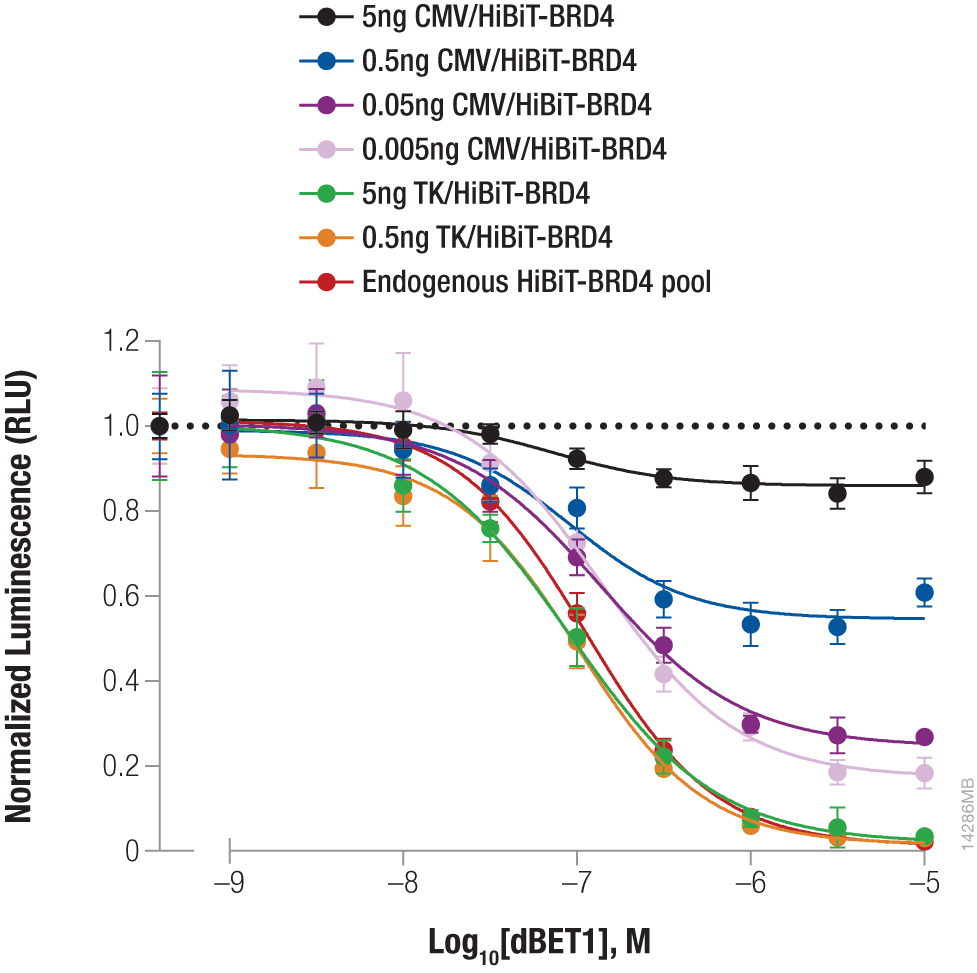
CRISPR knock-in of HiBiT at the BRD4 locus was used to measure protein abundance following treatment with the dBET1 degrader. BRD4 under native regulation was compared with different dilutions of CMV or TK-driven overexpression. Cells were treated with a titration of dBET1 and protein abundance was measured by quantifying the HiBiT tag (using the Nano-Glo® HiBiT Lytic Detection System).
Endogenous Target Expression Reveals Degrader Activity Missed by Ectopic Overexpression
Using endogenous target expression in degrader screens can reveal degraders that may be missed by ectopic overexpression models.
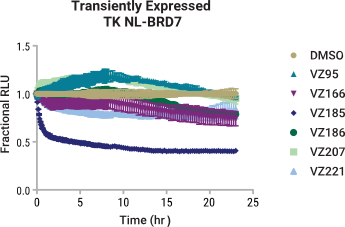
Transient Target Expression
Endogenous Target Expression
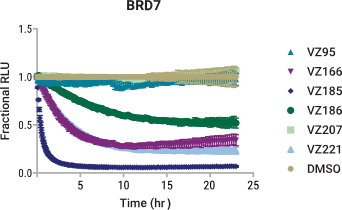
Cells expressing transiently overexpressed TK-NL-BRD7 (left) or endogenous BRD7 (right) were treated with the indicated compounds or DMSO control, and luminescent signal was monitored over 25 hours. The endogenous expression panel revealed degradation activity for multiple compounds (e.g., VZ95, VZ207, VZ221) that appeared inactive in the ectopic system, demonstrating that overexpression models can mask moderate degraders and lead to false negatives during screening.
Applications of CRISPR Knock-In Gene Editing
Targeted Protein Degradation

Selectively targeting proteins for removal from cells is a promising new modality for potential therapy. Watch this webinar to learn about pairing CRISPR-knock-in cell lines with TPD studies.
Gene Expression Modulation

Oligotherapeutics have advanced rapidly, but highthroughput, quantitative gene expression measurement remains a challenge. View our poster explaining more about these solutions.
Protein Dynamics

Studying protein dynamics is often slow and disruptive. Here, we show how a single HiBiT knock-in can track localization, interactions, and kinetics of a key chromatin remodeler. Read the article to learn more.
Resources for HiBiT-Tagging in CRISPR Cell Lines
Webinar
Understanding Your Options with CRISPR-Mediated Tagging.
Article
Learn How Researchers Tag Endogenous Proteins Small, Luminescent Peptides.
Application Note
Create Reporter Knock-In Cells with Our Optimized Guide.
FAQ
Answers to common questions about HiBiT tagging, CRISPR knock-ins, assay setup and more.
Interested in more physiologically relevant research tools?
Explore our full portfolio of tools for detecting biologically relevant protein dynamics and cellular activity.