Targeted Protein Degradation
We support targeted protein degradation (TPD) research with tools and services to study modulated protein dynamics within the cellular environment:
- CRISPR-edited HiBiT knock-in cells provide sensitive quantitation of target protein degradation in both live-cell and lytic assay formats.
- Lumit® Immunoassays to quantify target-protein levels in relevant cell backgrounds
- NanoBRET® Assays to investigate ternary complex formation, target ubiquitination, and compound binding or permeability
- HaloPROTAC3 degrader to assess the biological impact of targeted protein removal
Need help with assay development, compound screening or profiling?
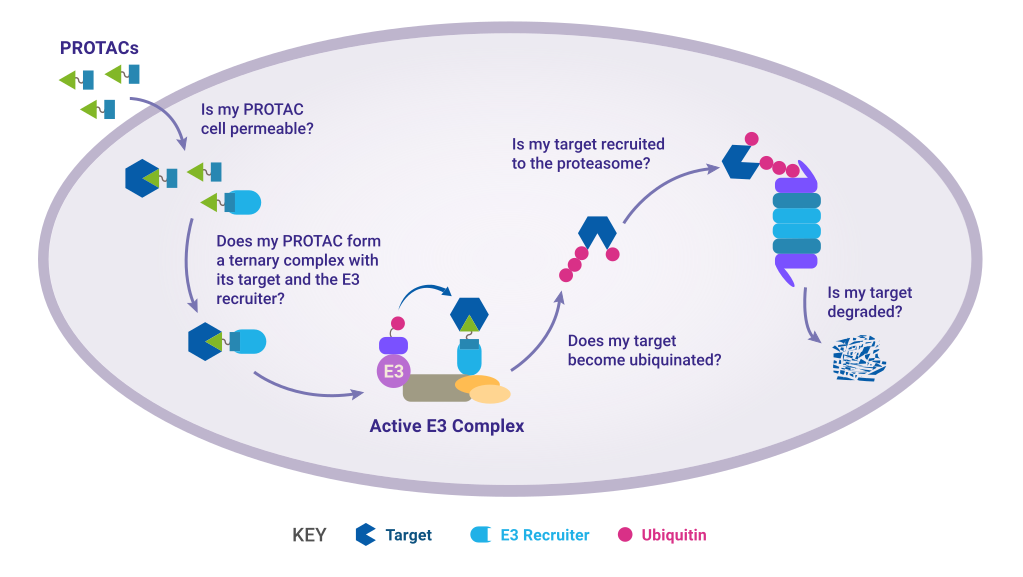
Key Questions To Consider When Developing Protein Degraders
Targeted protein degradation is a drug discovery approach that removes specific proteins from the cell instead of inhibiting their activity. This strategy takes advantage of the cell’s own ubiquitin–proteasome system (UPS) to degrade proteins that play a role in disease or are otherwise hard to target with conventional inhibitors. Molecules like PROTACs and molecular glues initiate this process by linking a target protein to an E3 ligase, leading to its ubiquitination and degradation. Studying how these degraders work in cells is essential for advancing TPD-based therapies.
We offer a portfolio of cell-based and biochemical assays for developing effective protein degraders. The approach is built around five key questions any degrader program should answer:
Featured Products for Studying Targeted Protein Degradation
| Area of Interest | Featured Product | Application |
|---|---|---|
| Target degradation | ViaScript™ LgBiT mRNA Delivery System | Rapid, uniform intracellular LgBiT expression for live-cell kinetic analysis |
| CRISPR HiBiT Knock-In Cell Lines and Clones | Endogenously tagged targets for degradation studies under native expression | |
| Lumit® Immunoassay Cellular Systems | Quantify target protein levels in native, non-modified cells | |
| Compound permeability and target affinity | NanoBRET® TE Intracellular E3 Ligase Assays (CRBN, VHL) | E3 ligase affinity in live vs. permeabilized cells; intracellular availability |
| Ternary complex formation | CRBN and VHL Ternary Complex Assay Starter Kits | Cell-based endpoint or kinetic measurement of ternary complex formation |
| Lumit® Anti-Tag Protein Interaction Reagents | Biochemical ternary complex formation across E3 ligases and targets | |
| Target ubiquitination | NanoBRET® Ubiquitination Starter Kit | Build target-specific live-cell assays measuring all ubiquitination types |
| Lumit® Immunoassay Cellular Systems | Biochemical detection of target and E3 ligase ubiquitination | |
| Phenotypic consequence of degradation | HaloPROTAC3 | VHL-mediated degradation of HaloTag® fusions for phenotypic studies |

Nano-Glo® HiBiT Lytic Detection System
Quantify HiBiT-tagged proteins with high sensitivity and a broad dynamic range using a simple add-mix-read assay format.

ViaScript™ LgBiT mRNA Delivery System
Achieve efficient and uniform expression of intracellular LgBiT for live-cell analysis of HiBiT-tagged proteins.
Targeted Protein Degradation Services
Obtain the data you need on end-point or kinetic target degradation, neosubstrate panel profiling, ternary complex formation, ubiquitination or permeability/affinity assessment.
Featured Resources

Article: Selective Degrader Against Cancer Cell Lines
Read this press release about a recent collaboration to develop a selective CK1α degrader with antiproliferative effects.

Slide Deck: Enabling Discovery of Targeted Protein Degraders
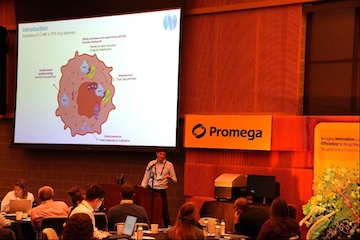
View this slide deck presented by Promega Scientist Dr. Kristin Riching at the 2024 TPD European Summit.

App Note: Monitoring Ternary Complex Formation
Learn about a simple bioluminescent method for high throughput screening of PROTACs.
Need help with Assay Development, Screening or Profiling?
Learn more about our targeted protein degradation services.